02 / REUSE ECONOMY
Textiles
A reuse economy offers an opportunity to address the environmental, social, and economic challenges associated with the textile industry while promoting sustainability, circularity, and community resilience.
BROWSE resources
THE SECTOR AT A GLANCE
The fourth-largest source of environmental pressure — and a moment to change course.
Textile products are the fourth largest source of environmental pressure after food, housing, and transport.
The textile supply chain is responsible for 15% of primary raw material consumption in EU households — and the rise of fast fashion has led to overconsumption and increased volumes of low-quality textiles unsuitable for reuse or recycling.
- 01
Collect & sort
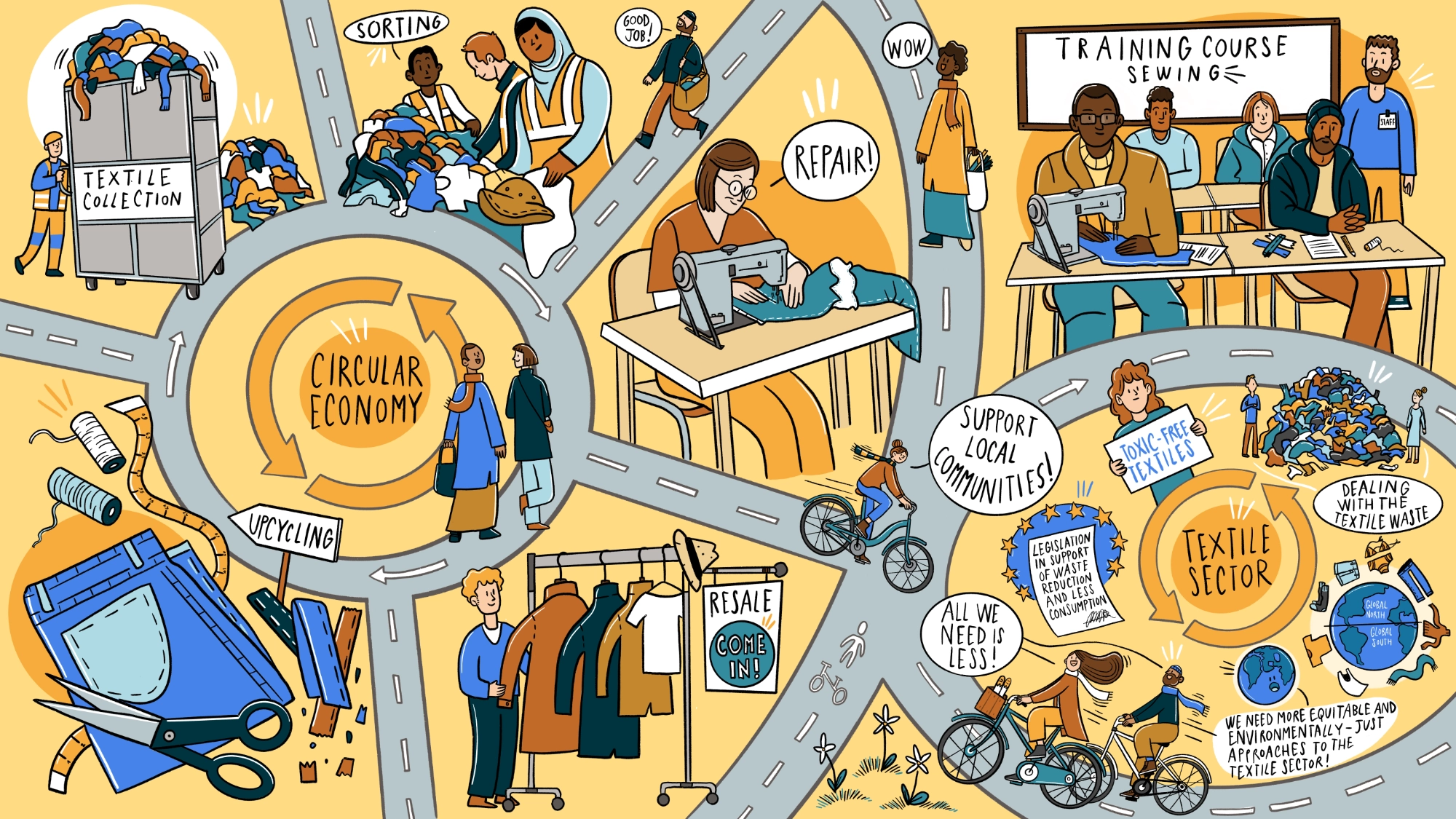
Reusing textiles is the most sustainable approach to closing the textile loop. Textiles can be repaired, resold, and upcycled through collection and sorting.
- 02
Repair & upcycle
A reuse economy focuses on extending the lifespan of textiles through repair and refurbishment.
- 03
Train & employ
Social enterprises for textiles play a crucial role in providing essential skills training and employment.
- 04
Resell locally
Local second-hand clothing markets keep textiles in use for longer, and deliver social benefits through local employment, training, and community-based reuse initiatives.
- 05
Produce Less
By keeping clothing in circulation for longer we can reduce the need to produce new textiles.
The textile sector, today.
The rise of fast fashion has led to overconsumption and increased volumes of low-quality textiles unsuitable for reuse or recycling. There is a lack of pre-consumer textile sytems and a lot of downcycling. To address this, a reuse economy focuses on extending the lifespan of textiles through repair, refurbishment, and resale, diverting them from landfills and incinerators.
Resource efficiency and circularity are crucial for a sustainable textile supply chain, mitigating environmental and social impacts like labor exploitation and unethical production practices. Textile reuse systems create employment opportunities, support local communities, and foster social cohesion.
PER EU CITIZEN / YEAR
26kg
of textiles are consumed on average by EU citizens per year, with 81% EU citizens consume an average of 26 kg of textiles per year.
Clothing makes up 81% of textile consumption. Globally, 73% of textiles end up in landfill or incineration, and the textile supply chain is responsible for 15 % of primary raw material consumption in EU households
WHO IS WORKING ON TEXTILE REUSE
Who is working on reusing textiles
Reusing textiles locally is the most sustainable approach to closing the textile loop while creating local jobs. Social enterprises in the textile reuse sector focus on implementing the textile waste hierarchy and respecting the proximity principle, extending the lifespan of textile products and fostering local skills development each — generates between 20 and 35 jobs per 1,000 tonnes of textiles collected for reuse.
NETWORK · RREUSE
A European network for textiles in the circular economy.
RREUSE, a European network representing social enterprises in the circular economy, advocates for a strong circular economy for textiles, driven by social purposes, emphasizing the role of social enterprises in the value chain.However, increasing amounts of low-quality textiles challenge the current model of textile management, funded mainly through the sale of second-hand clothes. The updated EU waste law requires a separate collection of textiles by 2025, presenting opportunities for value recapture, but addressing issues like garment quality and overproduction and consumption levels is crucial to avoid exacerbating economic challenges and disrupting existing business models.
VISIT RREUSE

COALITION · WADRDROBE CHANGE
A civil society coalition calling for EU action.
Wardrobe Change is a coalition of civil society organisations calling for EU action to address the textile industry's environmental impact. Their demands include:
- Clear design standards
- Addressing overproduction
- Banning the destruction of unsold goods
- Improving Extended Producer Responsibility (EPR) schemes
- Ensuring supply chain transparency
- Combating greenwashing
VISIT WARDROBE CHANGE
RESOURCES
Reports, briefs & movement voices

Packaging
The Business Case for Reusable Packaging
Lorem Ipsum dolor sit amet, consectetur adipiscing elit. Nunc vulputate libero et velit interdum, ac aliquet odio mattis.
READ MORE
Packaging
The Business Case for Reusable Packaging
Lorem Ipsum dolor sit amet, consectetur adipiscing elit. Nunc vulputate libero et velit interdum, ac aliquet odio mattis.
READ MORE
Packaging
The Business Case for Reusable Packaging
Lorem ipsum dolor sit amet, consectetur adipiscing elit. Etiam eu turpis molestie, dictum est a, mattis tellus.
READ MORE
Packaging
The Business Case for Reusable Packaging
Lorem ipsum dolor sit amet, consectetur adipiscing elit. Etiam eu turpis molestie, dictum est a, mattis tellus.
READ MORE
Textiles
Open letter: Textile Emergency Action Plan needed quickly
Zero Waste Europe
In this open letter, RREUSE, ACR+, and ZWE call on EU and national policymakers to take urgent action to prevent the collapse of the used textile value chain. In less than two months, separate textile waste collection will become mandatory in the EU.
READ MORE
CONTINUE EXPLORING
Explore the reuse economy by sector
01 / Sector
Electronics
Electronics must be designed in a way that prioritizes durability, repairability, and compatibility with reused parts.
03 / Sector
Packaging
Reusable packaging systems are a key solution to the growing problem of single-use packaging. Designed for multiple uses throughout their lifespan, reusable packaging is returned, refilled, and reused for the same purpose, reducing waste and the demand for new materials.
Sign Up to our Newsletter
Sign up for the #WeChooseReuse newsletter and stay up-to-date with the latest reuse news from Europe and beyond.