In Germany, reverse vending machines (RVM) have been a familiar part of everyday life since the 1990s, standing in supermarkets nationwide to take back the full range of drink containers, from refillable glass and PET bottles to single use cans and plastic.



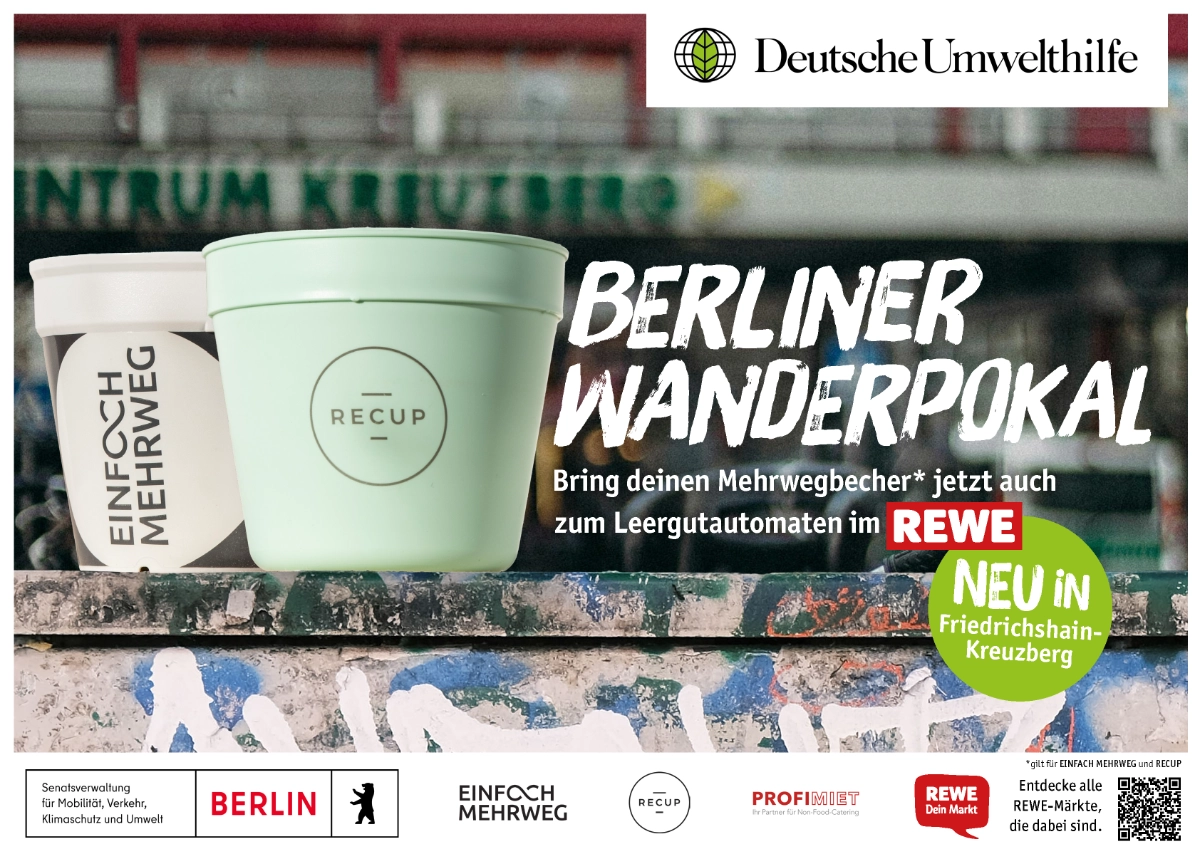
A year long pilot in Berlin gave reverse vending machines a new job: taking back reusable takeaway cups. Namely by having two independent reuse systems, Recup and Sykell (Einfach Mehrweg), share one single infrastructure for the first time, using the same reverse vending machines and the same return logistics such as collection, transport and cleaning.
A twelve month pilot, from March 2025 to March 2026, in Berlin's Friedrichshain-Kreuzberg district brought a broad German coalition together to test this reuse pilot: Deutsche Umwelthilfe (DUH) led the project with the support of the Berlin Senate; the supermarket chain Rewe and reusable cup provider Recup; Sykell and Profimiet handled logistics and cleaning; the RVM manufacturers Sielaff and Tomra; and the Kühne Logistics University accompanied the project scientifically.
Instead of building an entirely new return network, the project interconnected the well-established Recup reusable cup system with the reuse infrastructure that was already in place in Rewe stores through Sykell's Einfach Mehrweg reuse system. Consumers borrowed Recup reusable cups at a participating café or restaurant and returned it at a Rewe store using the RVMs reclaiming their deposit through the usual receipt at the cashier. Behind the scenes, the returned cups were collected, transported and industrially cleaned through the established and centralised reuse infrastructure before being placed back into circulation.
The findings are based on a comprehensive analysis by all pilot partners as well as the evaluation conducted by the Kühne Logistics University (KLU). For this scientific evaluation, KLU drew on surveys of 20 restaurants and coffee shops, 254 consumers, and seven of the eight participating Rewe supermarkets.
One central finding is that a centralised return and cleaning system can be shared across several reuse systems, provided they agree on a common labelling standard for machine recognition. Getting the RVMs to accept Recup cups turned out to be quite simple: a software update to the existing Sielaff and Tomra RVMs was enough and within the pilot this required no costs because compatibility was achieved simply by activating the cups in the machines' database.
Two additional elements made the pilot work. First, each cup carried two codes applied as stickers: a Data Matrix code which allows the machine to recognise and scan the cup at return and a QR code which allows each individual cup to be tracked through the system. This combination anticipates the kind of digital labelling and serialisation approach that the EU Packaging and Packaging Waste Regulation (PPWR) will require for reusable packaging. Second, the logistics ran on shared infrastructure. Returned Recup cups were collected in the same reusable transport crates as Sykell's existing Einfach Mehrweg system, moved through Rewe's logistics to the cleaning provider Profimiet and scanned there using Sykell's Circular ERP software to match returns with re-deliveries, before going back to the Recup warehouse and on to the participating cafés and restaurants. Profimiet handled the water and resource efficient industrial cleaning.
.webp)
Acceptance among consumers was very high. Around 95 percent of the Berliners surveyed found returning cups through supermarket RVMs practical and more than 80 percent (84 percent in 2025, 83 percent in 2026) argued they would prefer reuse over single use if return at retail were generally possible. Data from a small user batch also showed an initial pattern: many people returned their cups together with their deposit bottles, building on behaviour learned over decades.
Externalising the take-back and washing of cups relieves a sector under real staffing pressure. A restaurant's and coffee shop’s core business is selling food and drink and as reuse scales up, frequent manual collection and washing would add considerable work. Interviews with participating restaurants and coffee shops showed that the returns at supermarket premises ease this burden and make reuse noticeably more attractive to offer for these gastronomic players. Along these lines, more than 70 percent of gastronomic operators said they would like to see return via supermarket reverse vending machines expanded.
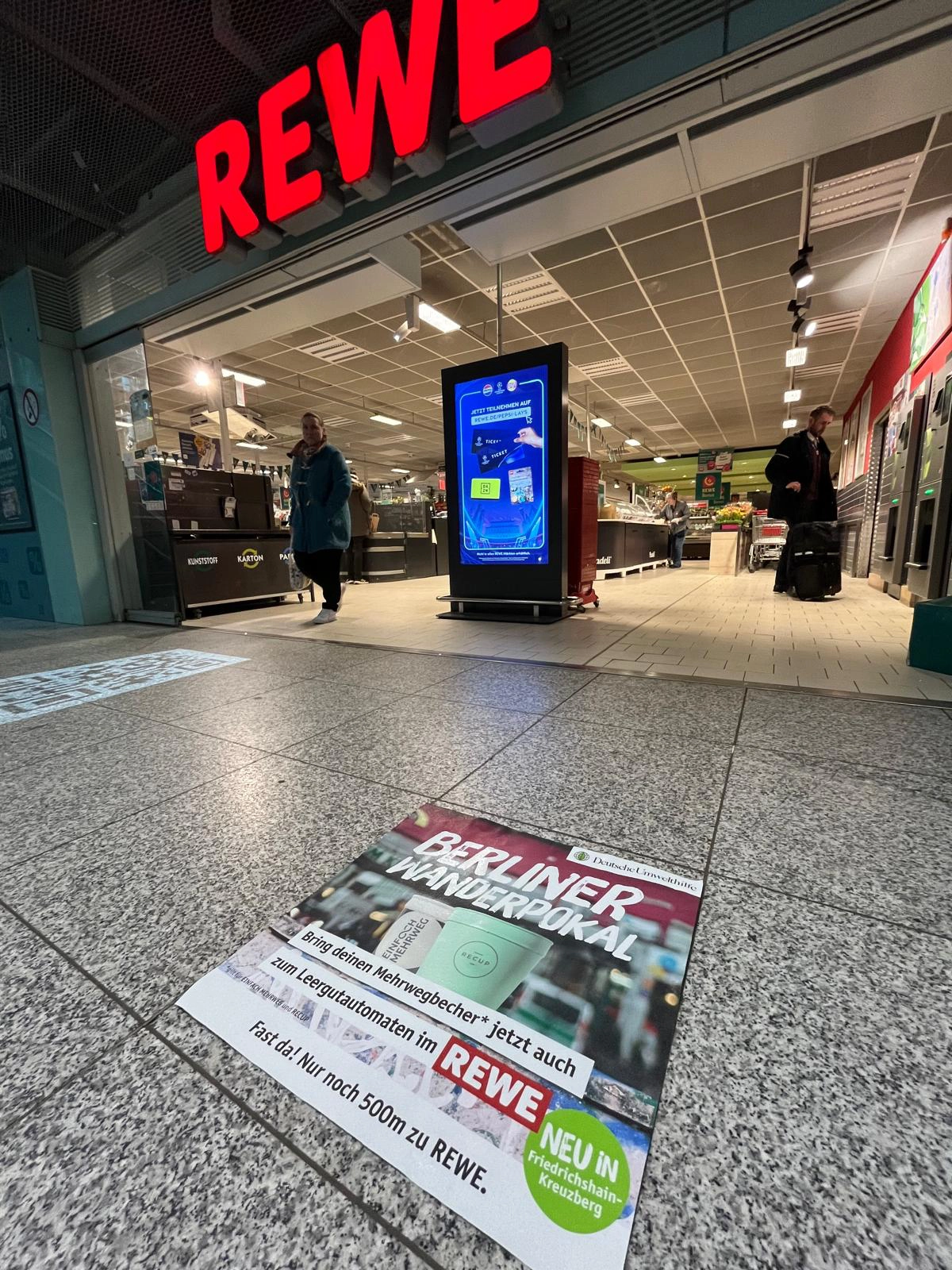
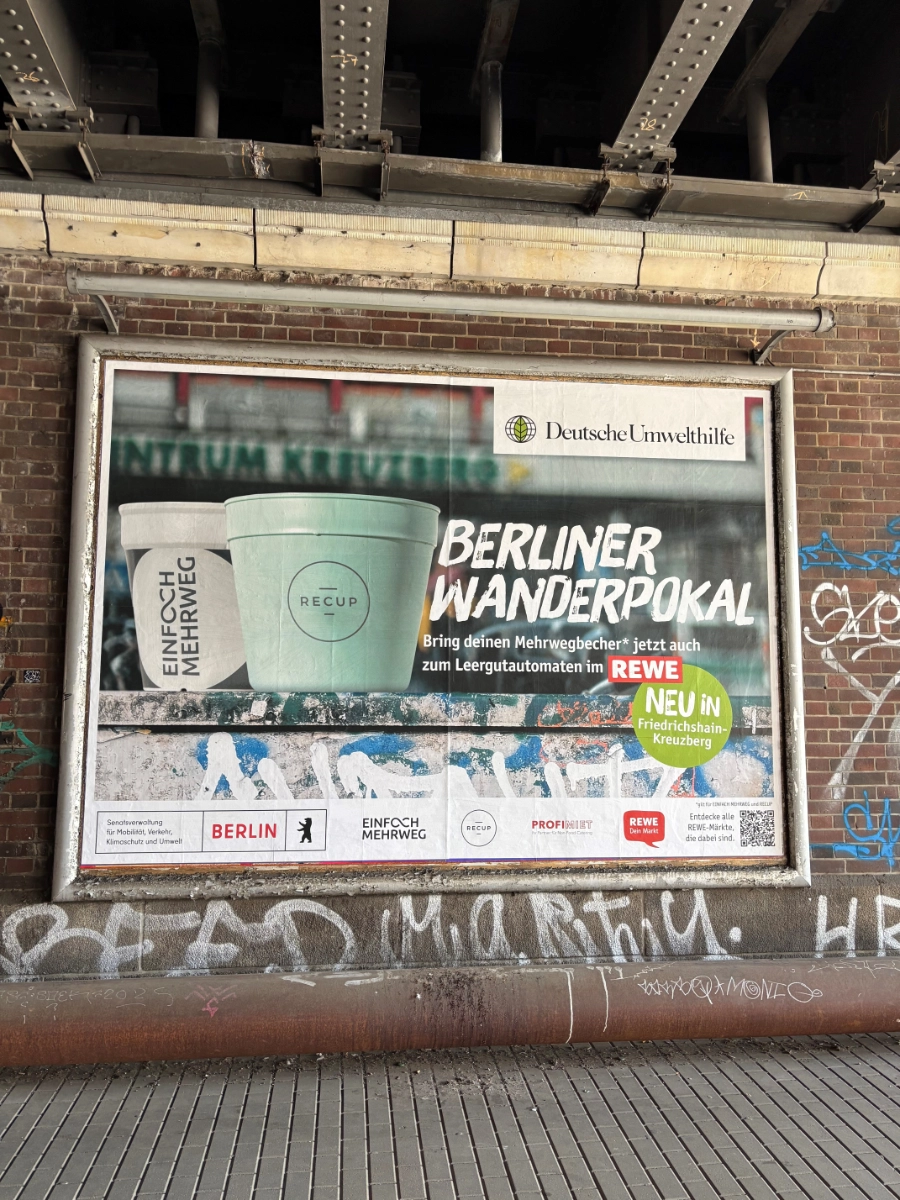
Accompanying information campaigns, both online and offline, raised awareness throughout the pilot (posts about the project reached around 360,000 impressions by its ending). Promoting the return option directly at the point of sale and at the reverse vending machines proved to be a particularly important point of contact for consumers. Displays, leaflets and stickers at the entrances and checkouts of the participating cafés and restaurants as well as at the reverse vending machines in the Rewe stores, thus made the way the system works visible to consumers at every step of the process – from borrowing to return. However, above all speaking to consumers directly and in person at the point of sale had a decisive influence on return behaviour which is why thorough training of gastronomy staff matters. The effect was clearest in October 2025 at the Moorathon, a Berlin climate campaign where Recup handed out 500 free coffees in reusable cups: participants were actively informed about the return option and monitoring showed returns tripling in the two weeks around the event compared with the week before.
The significance of the Berlin pilot lies in its system design. It provides evidence that a shared reuse infrastructure and logistics used jointly by several reuse systems is feasible under real operating conditions. Berlin therefore functions as a model that political decision-makers and reuse operators can adapt, both within the German national context and beyond it. At scale, moreover, the joint use of a single infrastructure across multiple reuse systems could lower circulation costs per container by up to 60 percent.
The pilot carries an equally clear political implication. At the German national level, the central requirement is a take back obligation in food retail covering all pooled reusable takeaway systems supported by a binding and adequately funded financing mechanism and a uniform labelling standard that ensures interoperability between systems and recognisability for consumers. At the European Union level, the Packaging and Packaging Waste Regulation requires member states to establish deposit return systems for single use plastic and metal beverage containers by 2029. As a new generation of reverse vending machines is developed to meet this obligation, reusable takeaway packaging should be incorporated into the RVM design respectively.
The Berlin pilot shows that scaling reuse is possible. What remains is not a technical challenge but a political one: to establish shared reuse infrastructure as the default and to ensure that those responsible for packaging bear the cost of financing it.
Sources and further reading
Lorem Ipsum dolor sit amet, consectetur adipiscing elit. Nunc vulputate libero et velit interdum, ac aliquet odio mattis.
Lorem Ipsum dolor sit amet, consectetur adipiscing elit. Nunc vulputate libero et velit interdum, ac aliquet odio mattis.
Lorem Ipsum dolor sit amet, consectetur adipiscing elit. Nunc vulputate libero et velit interdum, ac aliquet odio mattis.


A reuse economy needs support from strong legislation, and the WEEE Directive can play a crucial role in achieving this. However, some steps must be taken to support true resource efficiency and equitable access to reuse opportunities.
Sign up for the #WeChooseReuse newsletter and stay up-to-date with the latest reuse news from Europe and beyond.
No spam, ever. Unsubscribe any time.